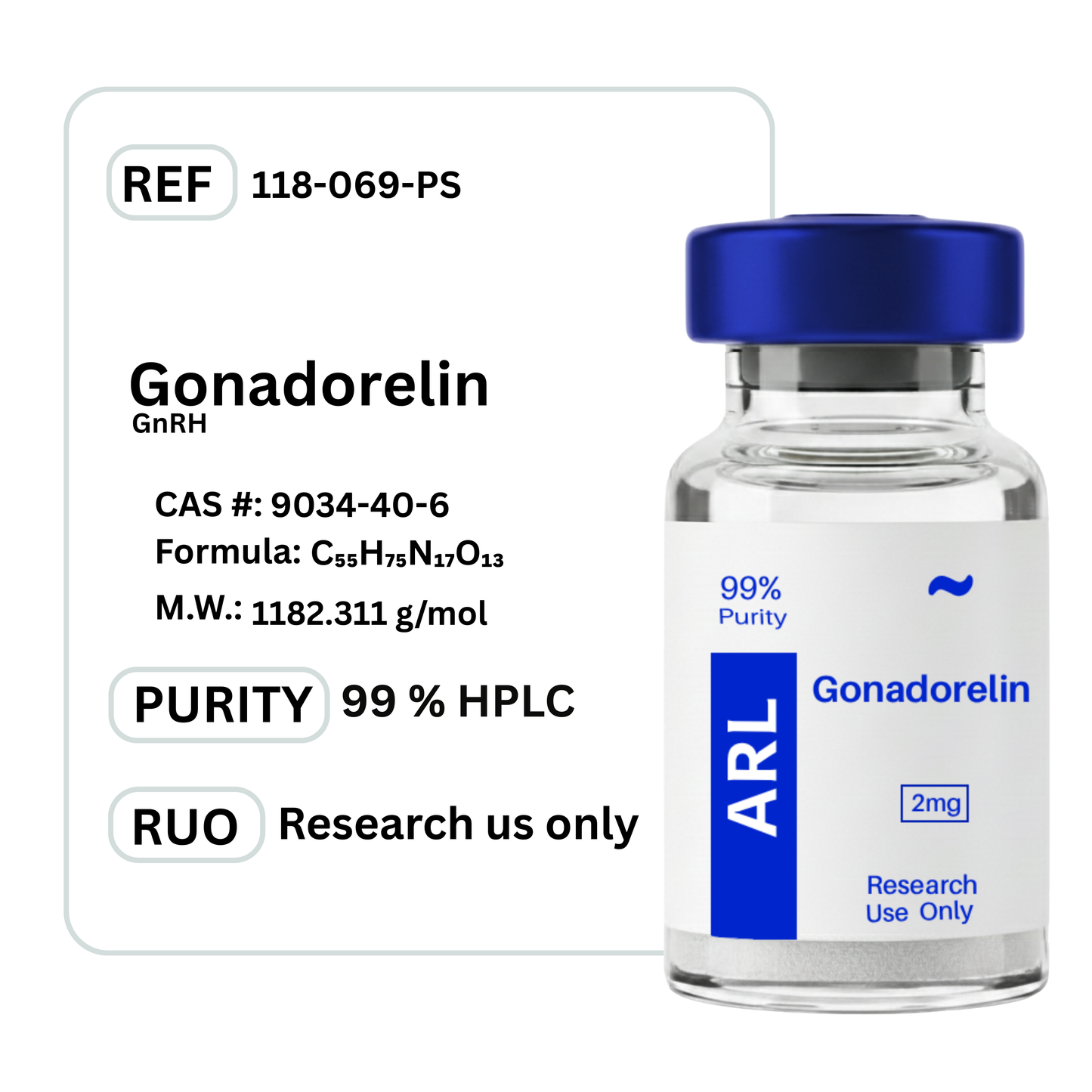
Gonadorelin
Gonadorelin
This batch of Gonadorelin Peptide has been third party lab tested and verified for quality.
Contents: Gonadorelin (Gonadotropin-Releasing Hormone, GnRH)
Form: Powder
Purity: 99.3%
Couldn't load pickup availability
Free Reconstitution Solution automatically added to your cart with each order.
This product is Made, Tested & Shipped From Canada.
Ships Today
Order by 1:00 PM EST
Free Shipping
For 2 or more vials
Verified+

Gonadorelin Overview
Gonadorelin, also known as Gonadotropin-Releasing Hormone (GnRH), is a synthetic decapeptide that serves as the primary mediator of the reproductive axis. As a potent agonist of the GnRH receptor, it acts directly on the anterior pituitary gland to stimulate the synthesis and pulsatile release of Luteinizing Hormone (LH) and Follicle-Stimulating Hormone (FSH). These gonadotropins are essential for regulating reproductive health, influencing the production of sex steroids in both males and females.
In clinical and laboratory settings, Gonadorelin is utilized to address conditions such as infertility, delayed puberty, and hypogonadism. Beyond traditional endocrine applications, cutting-edge research is investigating the potential of Gonadorelin and its analogues in oncology—specifically for breast and prostate cancer management—and in neurobiology for the potential mitigation of Alzheimer’s disease and cognitive decline.
Gonadorelin Structure
Gonadorelin is a peptide composed of a precise sequence of ten amino acids. Its structural integrity is vital for high-affinity binding to and activation of the GnRH receptor.
Structure Solution Formula: 5-oxo-L-prolyl-L-histidizing-L-tryptophyl-L-seryl-L-tyrosyl-glycyl-L-leucyl-L-arginyl-L-prolyl-glycinamide
Molecular Characteristics:
- Sequence: pyroGlu-His-Trp-Ser-Tyr-Gly-Leu-Arg-Pro-Gly-NH2
- Molecular Formula: C55H75N17O13
- Molecular Weight: 1182.3 g/mol
Gonadorelin Effects
Feature
Research Observations
Potential Application
Hormonal Regulation
Stimulates rapid release of LH and FSH from the pituitary
Fertility and endocrine diagnostics
Oncology (Breast)
Suppresses ovarian estrogen production over long-term use
Preventative therapy for high-risk profiles
Oncology (Prostate)
Induces medical castration via Combined Androgen Blockade
Management of hormone-sensitive malignancies
Neurological Impact
Modulates LH levels which influence amyloid-beta pathology
Cognitive health and Alzheimer's research
Metabolic Profile
High subcutaneous bioavailability in animal models
Efficient delivery for research protocols
Gonadorelin Research and Breast Cancer Prevention
Scientific investigations suggest that prolonged lifetime exposure to estrogen is a significant risk factor for the development of breast cancer. Factors such as early menarche, late menopause, and the use of exogenous hormone therapies contribute to this baseline risk. While estrogen-based contraceptives offer protection against ovarian cancer, they can present a complex risk profile regarding breast tissue.
Research indicates that Gonadorelin can be used to suppress ovarian estrogen production at the source. By minimizing the estrogen "fuel" that drives certain receptor-positive cancers, Gonadorelin may serve as a preventative measure. Longitudinal studies suggest that extended therapy—ranging from 10 to 15 years—could potentially reduce the risk of breast cancer by 60 percent to 70 percent in specific high-risk populations. Furthermore, because some cancers develop resistance to traditional anti-estrogens through receptor upregulation, suppressing estrogen production directly via Gonadorelin provides a secondary pathway to maintain therapeutic efficacy.
Gonadorelin: A Breakthrough in Prostate Cancer
Prostate cancer is recognized as one of the most hormone-sensitive malignancies. The primary therapeutic goal is often the total suppression of androgen flow. Historically, this required invasive surgical procedures, but the introduction of GnRH agonists like Gonadorelin allowed for "medical castration," a reversible and manageable alternative.
The application of Gonadorelin in Combined Androgen Blockade (CAB) has revolutionized the field. By combining GnRH analogues with other androgen-blocking agents, researchers have achieved success rates near 99 percent in cases where early detection is possible. Modern research continues to refine these protocols, developing new analogues with improved safety profiles that aim to prevent metastasis while potentially preserving other physiological functions.
Gonadorelin May Reduce Dementia Risk
Recent research highlights a link between reproductive hormones and the central nervous system. Luteinizing Hormone (LH) has been found to influence the hippocampus, the brain's primary center for memory. In animal models, elevated levels of LH are associated with increased amyloid-beta pathology, a hallmark of Alzheimer’s disease.
Studies utilizing Gonadorelin analogues suggest that suppressing LH may reduce the formation of amyloid plaques and lesions. There is also a focus on maintaining testosterone levels while selectively eliminating LH to preserve neural health. While leuprolide is currently a primary focus in this area, Gonadorelin remains a critical tool for understanding the tandem interaction between genetic loci like APOE and MS4A4A. Understanding how these genes respond to GnRH signaling is essential for developing future tests and preventative strategies for neurodegenerative conditions.
Gonadorelin Research
While Gonadorelin is a well-established decapeptide, its full range of applications in mammalian physiology continues to expand. From achieving nearly total control over hormone-sensitive prostate cancers to its emerging role in neuroprotection, the peptide serves as a cornerstone of endocrine research. Current studies are focused on its high subcutaneous bioavailability and its ability to regulate downstream hormones that impact both cellular oncology and cognitive longevity.
Gonadorelin is currently restricted to educational and scientific exploration. In vivo research in human subjects is prohibited outside of authorized clinical settings. Only licensed and accredited investigators may obtain Gonadorelin for laboratory use.
Article Author
The referenced literature was researched and organized by Dr. Logan, M.D. Dr. Logan holds a Doctorate from Case Western Reserve University School of Medicine and a Bachelor of Science in Molecular Biology.
Scientific Journal Author
Dr. Giorgio Secreto is a prominent researcher at the IRCCS National Cancer Institute in Italy. With a career spanning over four decades, Dr. Secreto has specialized in the role of androgens in breast cancer and endocrinology. He has held prestigious positions at the University of Milan and the University of Turin and has published approximately 150 papers on the efficacy of GnRH in managing hormonal levels.
Dr. Giorgio Secreto is recognized for his significant contributions to the understanding of Gonadorelin. His inclusion here is for the purpose of acknowledging his investigative work; he does not endorse or promote the sale or application of this compound. There is no affiliation between Peptide Sciences and Dr. Secreto.
Storage
To maintain the structural integrity and potency of Gonadorelin, it should be stored in a cool, dry place away from direct light. For long-term stability, lyophilized powder should be kept at temperatures below -20 degrees Celsius. Once reconstituted, the solution should be refrigerated at 2 to 8 degrees Celsius and used within a specific timeframe to ensure peptide stability.
Referenced Citations
- G. Secreto et al., "A novel approach to breast cancer prevention: reducing excessive ovarian androgen production in elderly women," Breast Cancer Res. Treat., vol. 158, no. 3, pp. 553–561, 2016.
- D. V. Spicer and M. C. Pike, "Sex steroids and breast cancer prevention," J. Natl. Cancer Inst. Monogr., no. 16, pp. 139–147, 1994.
- G. Secreto, P. Muti, M. Sant, E. Meneghini, and V. Krogh, "Medical ovariectomy in menopausal breast cancer patients with high testosterone levels: a further step toward tailored therapy," Endocr. Relat. Cancer, vol. 24, no. 11, pp. C21–C29, 2017.
- E. S. Volleard, A. P. van Beck, F. A. J. Verburg, A. Rozs, and J. A. Land, "Gonadotropin releasing hormone agonist treatment in premenopausal women with hyperandrogenism of ovarian origin," J. Clin. Endocrinol. Metab., vol. 96, no. 5, pp. 1197–1201, May 2011.
- F. Labrie, "Hormonal therapy of prostate cancer," Prog. Brain Res., vol. 182, pp. 321–341, 2010.
- F. Labrie, "GnRH agonists and the rapidly increasing use of combined androgen blockade in prostate cancer," Endocr. Relat. Cancer, vol. 21, no. 4, pp. R301–317, Aug. 2014.
- F. Labrie, "Combined blockade of testicular and locally made androgens in prostate cancer: a highly significant medical progress based upon intracrinology," J. Steroid Biochem. Mol. Biol., vol. 145, pp. 144–156, Jan. 2015.
- F. Labrie, "Keynote of endocrinology in the victory against prostate cancer," Bull. Cancer (Paris), vol. 93, no. 9, pp. 849–868, Sep. 2006.
- V. Burnham, C. Sundby, A. Laman-Maharg, and J. Thornton, "Luteinizing hormone acts at the hippocampus to dampen spatial memory," Horm. Behav., vol. 89, pp. 55–63, 2017.
- C. V. Rao, "Involvement of Luteinizing Hormone in Alzheimer Disease Development in Elderly Women," Reprod. Sci. Thousand Oaks Calif, vol. 24, no. 3, pp. 355–368, 2017.
- J. Lin et al., "Genetic ablation of luteinizing hormone receptor improves the amyloid pathology in a mouse model of Alzheimer disease," J. Neuropathol. Exp. Neurol., vol. 69, no. 3, pp. 253–261, Mar. 2010.
- R. L. Bowen, T. Butler, and C. S. Atwood, "Nad All Androgen Deprivation Therapies Are Created Equal: Leuprolide and the Decreased Risk of Developing Alzheimer's Disease," J. Clin. Oncol., vol. 34, no. 23, p. 2800, Aug. 2016.
- M. A. Smith, P. L. Bowen, R. O. Nguyen, G. Perry, C. S. Atwood, and A. A. Rimm, "Putative Gonadorelin Releasing Hormone Against Therapy and Dementia: An Application of Medicare Hospitalization Claims Data to PLA JAD, vol. 63, no. 4, pp. 1259–1277, 2018.
- A. Clelems, J. E. Vargas, and J. R. Gonzalez, "APOE and MS4A4A interact with GnRH signaling in Alzheimer's disease: Disrupting in mab and Alzheimer Dement. J. Alzheimers Assoc., vol. 13, no. 4, pp. 493–497, Apr. 2017.
-
check_circle
HIGHEST QUALITY PEPTIDES
Our products are scientifically formulated and manufactured in cGMP-compliant facilities.
-
encrypted
FAST DELIVERY
Enjoy fast and reliable 3–5 day shipping.
-
check_circle
Dedicated Customer Service
Our customer service team is highly knowledgeable in peptide research and its applications. We’re available 24/7 to assist you.
Verified reviews
Tested. Verified. Trusted.
We take a laboratory-first approach to quality. Each batch is made under controlled conditions and verified by an independent lab (HPLC/MS). We only ship batches that test ≥99% purity, and we provide a full COA, including identity, methods, and chromatograms, for your review.
You may also like
-
SAVE 25%Reconstitution Solution
Regular price $15.00Regular price $15.00 Sale priceUnit price / per$20.0025% -
SAVE 24%PEG MGF - Research Grade Peptide
Regular price $100.00Regular price $100.00 Sale priceUnit price / per$132.0024% -
SAVE 25%Tirzepatide
Regular price From $50.00Regular price From $50.00 Sale priceUnit price / per$67.0025% -
SAVE 24%Thymosin Alpha-1
Regular price From $79.00Regular price From $79.00 Sale priceUnit price / per$104.0024% -
SAVE 23%Tesamorelin
Regular price From $80.00Regular price From $80.00 Sale priceUnit price / per$105.0023% -
SAVE 23%Survodutide
Regular price $299.00Regular price $299.00 Sale priceUnit price / per$392.0023% -
SAVE 26%Sterile Water
Regular price From $14.00Regular price From $14.00 Sale priceUnit price / per$19.0026% -
SAVE 23%SLU-PP-332
Regular price $125.00Regular price $125.00 Sale priceUnit price / per$164.0023% -
SAVE 23%Sermorelin
Regular price From $70.00Regular price From $70.00 Sale priceUnit price / per$92.0023% -
SAVE 23%Semaglutide
Regular price From $36.00Regular price From $36.00 Sale priceUnit price / per$47.0023% -
SAVE 23%Retatrutide Triple Agonist
Regular price From $90.00Regular price From $90.00 Sale priceUnit price / per$118.0023% -
SAVE 24%PEG MGF - Premium Research Peptide
Regular price $100.00Regular price $100.00 Sale priceUnit price / per$132.0024% -
SAVE 26%Oxytocin Acetate
Regular price $42.00Regular price $42.00 Sale priceUnit price / per$57.0026% -
SAVE 25%Melanotan II (MT2)
Regular price $50.00Regular price $50.00 Sale priceUnit price / per$67.0025% -
SAVE 24%Lipo-C with B Vitamins
Regular price $85.00Regular price $85.00 Sale priceUnit price / per$112.0024% -
SAVE 23%Lemon Bottle
Regular price $80.00Regular price $80.00 Sale priceUnit price / per$105.0023% -
SAVE 23%L-Carnitine
Regular price $97.00Regular price $97.00 Sale priceUnit price / per$127.0023% -
SAVE 24%KPV Tripeptide
Regular price From $56.00Regular price From $56.00 Sale priceUnit price / per$74.0024% -
KLOW Blend - GHK-CU + TB-500 + BPC-157 + KPV 10mg
Regular price $200.00Regular price $200.00 Sale priceUnit price / per$261.0023% -
SAVE 23%Kisspeptin-10
Regular price From $65.00Regular price From $65.00 Sale priceUnit price / per$85.0023% -
SAVE 23%Ipamorelin
Regular price From $32.00Regular price From $32.00 Sale priceUnit price / per$42.0023% -
SAVE 24%IGF-DES - Premium Research Peptide
Regular price $60.00Regular price $60.00 Sale priceUnit price / per$79.0024% -
IGF-1 LR3 (Long R3) - Premium Research Peptide
Regular price From $40.00Regular price From $40.00 Sale priceUnit price / per$53.0024% -
SAVE 24%Hyaluronic
Regular price $28.00Regular price $28.00 Sale priceUnit price / per$37.0024% -
SAVE 23%HGH Fragment 176-191
Regular price $97.00Regular price $97.00 Sale priceUnit price / per$127.0023% -
SAVE 23%HGH 191AA (Somatropin)
Regular price From $55.00Regular price From $55.00 Sale priceUnit price / per$72.0023% -
SAVE 25%Gonadorelin
Regular price $50.00Regular price $50.00 Sale priceUnit price / per$67.0025% -
SAVE 23%Glutathione
Regular price $83.00Regular price $83.00 Sale priceUnit price / per$109.0023% -
SAVE 23%Glow BPC-157 + GHK-CU + TB-500
Regular price $139.00Regular price $139.00 Sale priceUnit price / per$181.0023%
Every vial we sell comes from a lab that follows current Good Manufacturing Practices (cGMP). That means each step of production is documented and controlled. Before a batch is released, it’s tested by independent third-party labs for purity, identity, and sterility. Certificates of analysis are available so you can see the exact test results.
Yes. The labs we work with use ISO-certified clean rooms where air quality, equipment, and handling procedures are tightly regulated. Staff are trained to pharmaceutical-grade standards. This ensures the peptides are produced in an environment that minimizes contamination risks.
Peptides in lyophilized (freeze-dried) form are stable at room temperature for transport. Once you receive them, refrigeration is recommended to maintain long-term integrity. We package every order securely to prevent damage and ship promptly, so your vials arrive in optimal condition.
We operate under strict in-house protocols that follow current Good Manufacturing Practices (cGMP). That means our team oversees the entire process from sourcing raw amino acids to the final lyophilized vial. Nothing is outsourced or repackaged. This gives us full control over purity, consistency, and sterility, and it’s why we can stand behind every single vial we ship.
Store them in the refrigerator, away from direct light and heat. If you need to keep them longer, some peptides can be stored frozen. Each vial comes with clear handling instructions so you know the proper conditions for stability.
The strongest proof is transparency. For every peptide, we can provide certificates of analysis, manufacturing documentation, and references to the published scientific research behind it. If you ever have questions, we’ll show you the data rather than ask you to take our word for it.
The difference is transparency. Most sites give you a product name and a price. We provide full batch testing, lab documentation, and direct access to certificates of analysis so you don’t have to guess what you’re getting. When you order from us, you know exactly what’s in the vial, where it was made, and how it was verified.