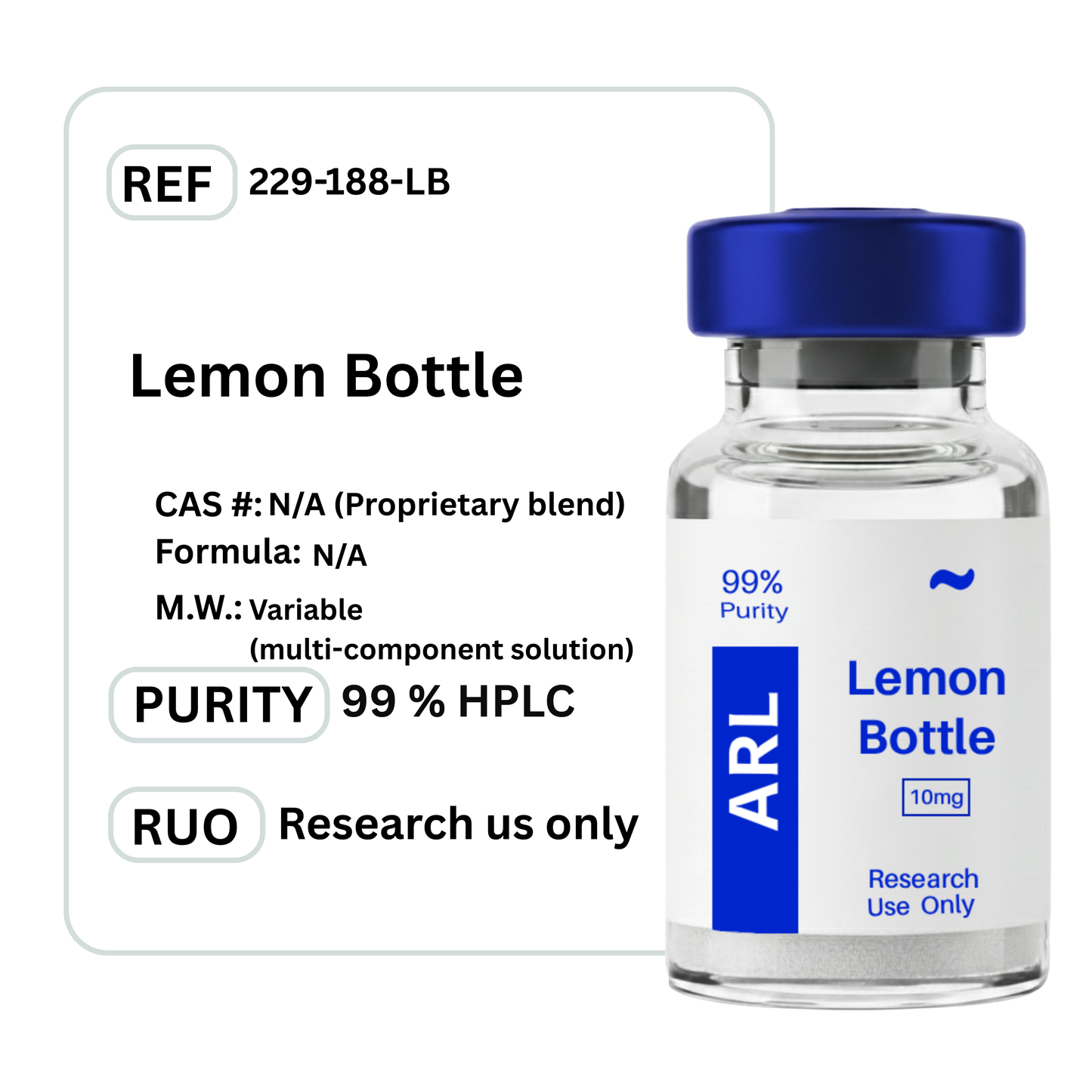
Lemon Bottle
Lemon Bottle
This batch of Lemon Bottle Peptide has been third party lab tested and verified for quality.
Contents: Lemon Bottle Complex (Phosphatidylcholine, Deoxycholic Acid, L-Carnitine, and Multivitamin Blend)
Form: Lyophilized Powder
Purity: 99.2%
Couldn't load pickup availability
Free Reconstitution Solution automatically added to your cart with each order.
This product is Made, Tested & Shipped From Canada.
Ships Today
Order by 1:00 PM EST
Free Shipping
For 2 or more vials
Verified+

Lemon Bottle - Research Lipolysis Solution Research
Adipocyte Lipolysis Research
Laboratory investigations focus on how specific elements within the Lemon Bottle formulation regulate the enzymatic breakdown of triglycerides. Research is directed toward the intracellular mechanisms that mobilize stored fats, specifically analyzing the activation of hormone-sensitive lipase and other enzymes that maintain the lipid balance within adipose cells.
Lipid Mobilization Pathways
Research efforts evaluate the efficiency of fatty acid transport and mitochondrial absorption. By examining the targeted activation of lipid oxidation mechanisms, scientists seek to determine how the formulation supports the conversion of sequestered lipids into usable cellular energy through enhanced metabolic signaling and upregulated oxidation pathways.
Localized Adiposity Models
Researchers utilize Lemon Bottle to conduct structural and biochemical assessments of adipocyte-dense tissues in both in vitro and in vivo experimental settings. These studies investigate changes in fat cell morphology, regional metabolic activity, and the overall capacity for energy storage within controlled environmental parameters.
Extracellular Matrix Response
Scientific evaluations assess the potential of this formulation to modulate extracellular matrix (ECM) remodeling. This includes the study of collagen turnover and cellular migration, which are critical for understanding how adipose tissue adapts to changes in lipid volume. Matrix flexibility and intercellular communication are primary focal points for these regeneration studies.
Article Author
This literature review was compiled, edited, and prepared by M. Lafontan, Ph.D.
Dr. Lafontan is a prominent expert in lipid metabolism, widely recognized for his pioneering work in adipocyte biology, lipolysis regulation, and lipid mobilization processes. His research has laid the groundwork for understanding the hormonal and metabolic mechanisms that control fat catabolism and the adaptive behavior of adipose tissue under both physiological and experimental conditions.
Scientific Journal Author
The research contributions of Dr. Michel Lafontan are supported and expanded upon by several notable metabolic scientists, including S. Patel, J.W. Choi, P. Strålfors, and W. Dijk. Together, their investigations have deepened scientific insight into adipose tissue remodeling, mitochondrial lipid oxidation, and the regulation of fatty acid metabolism. Their collective findings—featured in respected journals such as Progress in Lipid Research, Nature Reviews Molecular Cell Biology, Journal of Cosmetic Dermatology, Biochimica et Biophysica Acta, and Nature Metabolism—serve as key references for ongoing studies in adipocyte lipolysis and lipid signaling pathways.
This acknowledgment is provided solely to recognize the original scientific work of these researchers and their collaborators. It should not be construed as an endorsement or promotional statement regarding this product. Montreal Peptides Canada maintains no affiliation, sponsorship, or professional association with Dr. Lafontan or any of the authors cited.
Reference Citations
Lafontan M, et al. Regulation of human adipocyte lipolysis. Prog Lipid Res. 2010;49(4):275-297. PMID: 20171981. https://pubmed.ncbi.nlm.nih.gov/20171981/
Patel S, et al. Cellular mechanisms of lipolysis in adipocytes. Nat Rev Mol Cell Biol. 2022;23(5):275-290. PMID: 35131952. https://pubmed.ncbi.nlm.nih.gov/35131952/
Choi JW, et al. Local modulation of adipose tissue remodeling: experimental analysis. J Cosmet Dermatol. 2020;19(7):1663-1671. PMID: 31883211. https://pubmed.ncbi.nlm.nih.gov/31883211/
Strålfors P, et al. Hormonal and metabolic regulation of lipid breakdown. Biochim Biophys Acta. 2013;1831(6):1101-1108. PMID: 23201425. https://pubmed.ncbi.nlm.nih.gov/23201425/
Lafontan M. Advances in adipocyte biology and metabolic function. Ann Endocrinol. 2021;82(3-4):187-194. PMID: 34276019. https://pubmed.ncbi.nlm.nih.gov/34276019/
ClinicalTrials.gov Identifier: NCT05060296. Investigation of adipose remodeling in localized fat deposits. https://clinicaltrials.gov/ct2/show/NCT05060296
Dijk W, et al. Fat utilization and metabolic health. Nat Metab. 2020;2(4):325-334. PMID: 32203414. https://pubmed.ncbi.nlm.nih.gov/32203414/
Storage
Storage Instructions
All products are produced through a lyophilization (freeze-drying) process, which preserves stability during shipping for approximately 3 to 4 months. After reconstitution with bacteriostatic water, peptides must be stored in a refrigerator to maintain their effectiveness. Once mixed, they remain stable for up to 30 days.
Lyophilization, also known as cryodesiccation, is a specialized dehydration method in which peptides are frozen and exposed to low pressure. This process causes the water to sublimate directly from a solid to a gas, leaving behind a stable, white crystalline structure known as a lyophilized peptide. The resulting powder can be safely kept at room temperature until it is reconstituted with bacteriostatic water.
For extended storage periods lasting several months to years, it is recommended to keep peptides in a freezer at -80 degrees Celsius (-112 degrees Fahrenheit). Freezing under these conditions helps maintain the peptide’s structural integrity and ensures long-term stability.
Best Practices For Storing Peptides
Proper storage of peptides is critical to maintaining the accuracy and reliability of laboratory results. Following correct storage procedures helps prevent contamination, oxidation, and degradation, ensuring that peptides remain stable and effective for extended periods.
- Initial Receipt: Upon receiving peptides, keep them cool and protected from light. For short-term use, refrigeration below 4 degrees Celsius (39 degrees Fahrenheit) is sufficient.
- Temperature Consistency: Minimize freeze-thaw cycles. Repeated temperature fluctuations can accelerate the degradation of the peptide bonds.
- Equipment Choice: Avoid frost-free freezers. These units undergo regular temperature variations during their defrosting cycles, which can compromise the integrity of the lyophilized powder.
Preventing Oxidation and Moisture Contamination
Protecting peptides from air and moisture is essential. Moisture contamination is particularly common when removing peptides from frozen storage. To avoid condensation forming on the cold peptide or inside the vial, always allow the container to reach room temperature before opening.
Minimize air exposure by keeping the container closed whenever possible. After removing the required amount for research, reseal the vial promptly. For peptides containing cysteine, methionine, or tryptophan residues, extra care is required as they are highly sensitive to oxidation. Storing these under a dry, inert gas like nitrogen can further preserve the sample.
Storing Peptides In Solution
Peptide solutions have a significantly shorter shelf life than their lyophilized counterparts. They are more susceptible to bacterial degradation and chemical breakdown. If storage in solution is necessary:
- Use sterile buffers with a pH between 5 and 6.
- Divide the solution into small aliquots to prevent repeated thawing of the entire stock.
- Refrigerated solutions at 4 degrees Celsius (39 degrees Fahrenheit) generally remain stable for up to 30 days.
Peptide Storage Containers
Containers must be clean, clear, durable, and chemically resistant. High-quality glass vials provide the best overall characteristics for storage, offering maximum chemical inertness. While many peptides are shipped in plastic (polystyrene or polypropylene) to prevent breakage during transit, researchers may transfer them to glass vials if specific experimental protocols require higher chemical resistance.
-
check_circle
HIGHEST QUALITY PEPTIDES
Our products are scientifically formulated and manufactured in cGMP-compliant facilities.
-
encrypted
FAST DELIVERY
Enjoy fast and reliable 3–5 day shipping.
-
check_circle
Dedicated Customer Service
Our customer service team is highly knowledgeable in peptide research and its applications. We’re available 24/7 to assist you.
Verified reviews
Tested. Verified. Trusted.
We take a laboratory-first approach to quality. Each batch is made under controlled conditions and verified by an independent lab (HPLC/MS). We only ship batches that test ≥99% purity, and we provide a full COA, including identity, methods, and chromatograms, for your review.
You may also like
-
SAVE 25%Reconstitution Solution
Regular price $15.00Regular price $15.00 Sale priceUnit price / per$20.0025% -
SAVE 24%PEG MGF - Research Grade Peptide
Regular price $100.00Regular price $100.00 Sale priceUnit price / per$132.0024% -
SAVE 25%Tirzepatide
Regular price From $50.00Regular price From $50.00 Sale priceUnit price / per$67.0025% -
SAVE 24%Thymosin Alpha-1
Regular price From $79.00Regular price From $79.00 Sale priceUnit price / per$104.0024% -
SAVE 23%Tesamorelin
Regular price From $80.00Regular price From $80.00 Sale priceUnit price / per$105.0023% -
SAVE 23%Survodutide
Regular price $299.00Regular price $299.00 Sale priceUnit price / per$392.0023% -
SAVE 26%Sterile Water
Regular price From $14.00Regular price From $14.00 Sale priceUnit price / per$19.0026% -
SAVE 23%SLU-PP-332
Regular price $125.00Regular price $125.00 Sale priceUnit price / per$164.0023% -
SAVE 23%Sermorelin
Regular price From $70.00Regular price From $70.00 Sale priceUnit price / per$92.0023% -
SAVE 23%Semaglutide
Regular price From $36.00Regular price From $36.00 Sale priceUnit price / per$47.0023% -
SAVE 23%Retatrutide Triple Agonist
Regular price From $90.00Regular price From $90.00 Sale priceUnit price / per$118.0023% -
SAVE 24%PEG MGF - Premium Research Peptide
Regular price $100.00Regular price $100.00 Sale priceUnit price / per$132.0024% -
SAVE 26%Oxytocin Acetate
Regular price $42.00Regular price $42.00 Sale priceUnit price / per$57.0026% -
SAVE 25%Melanotan II (MT2)
Regular price $50.00Regular price $50.00 Sale priceUnit price / per$67.0025% -
SAVE 24%Lipo-C with B Vitamins
Regular price $85.00Regular price $85.00 Sale priceUnit price / per$112.0024% -
SAVE 23%Lemon Bottle
Regular price $80.00Regular price $80.00 Sale priceUnit price / per$105.0023% -
SAVE 23%L-Carnitine
Regular price $97.00Regular price $97.00 Sale priceUnit price / per$127.0023% -
SAVE 24%KPV Tripeptide
Regular price From $56.00Regular price From $56.00 Sale priceUnit price / per$74.0024% -
KLOW Blend - GHK-CU + TB-500 + BPC-157 + KPV 10mg
Regular price $200.00Regular price $200.00 Sale priceUnit price / per$261.0023% -
SAVE 23%Kisspeptin-10
Regular price From $65.00Regular price From $65.00 Sale priceUnit price / per$85.0023% -
SAVE 23%Ipamorelin
Regular price From $32.00Regular price From $32.00 Sale priceUnit price / per$42.0023% -
SAVE 24%IGF-DES - Premium Research Peptide
Regular price $60.00Regular price $60.00 Sale priceUnit price / per$79.0024% -
IGF-1 LR3 (Long R3) - Premium Research Peptide
Regular price From $40.00Regular price From $40.00 Sale priceUnit price / per$53.0024% -
SAVE 24%Hyaluronic
Regular price $28.00Regular price $28.00 Sale priceUnit price / per$37.0024% -
SAVE 23%HGH Fragment 176-191
Regular price $97.00Regular price $97.00 Sale priceUnit price / per$127.0023% -
SAVE 23%HGH 191AA (Somatropin)
Regular price From $55.00Regular price From $55.00 Sale priceUnit price / per$72.0023% -
SAVE 25%Gonadorelin
Regular price $50.00Regular price $50.00 Sale priceUnit price / per$67.0025% -
SAVE 23%Glutathione
Regular price $83.00Regular price $83.00 Sale priceUnit price / per$109.0023% -
SAVE 23%Glow BPC-157 + GHK-CU + TB-500
Regular price $139.00Regular price $139.00 Sale priceUnit price / per$181.0023%
Every vial we sell comes from a lab that follows current Good Manufacturing Practices (cGMP). That means each step of production is documented and controlled. Before a batch is released, it’s tested by independent third-party labs for purity, identity, and sterility. Certificates of analysis are available so you can see the exact test results.
Yes. The labs we work with use ISO-certified clean rooms where air quality, equipment, and handling procedures are tightly regulated. Staff are trained to pharmaceutical-grade standards. This ensures the peptides are produced in an environment that minimizes contamination risks.
Peptides in lyophilized (freeze-dried) form are stable at room temperature for transport. Once you receive them, refrigeration is recommended to maintain long-term integrity. We package every order securely to prevent damage and ship promptly, so your vials arrive in optimal condition.
We operate under strict in-house protocols that follow current Good Manufacturing Practices (cGMP). That means our team oversees the entire process from sourcing raw amino acids to the final lyophilized vial. Nothing is outsourced or repackaged. This gives us full control over purity, consistency, and sterility, and it’s why we can stand behind every single vial we ship.
Store them in the refrigerator, away from direct light and heat. If you need to keep them longer, some peptides can be stored frozen. Each vial comes with clear handling instructions so you know the proper conditions for stability.
The strongest proof is transparency. For every peptide, we can provide certificates of analysis, manufacturing documentation, and references to the published scientific research behind it. If you ever have questions, we’ll show you the data rather than ask you to take our word for it.
The difference is transparency. Most sites give you a product name and a price. We provide full batch testing, lab documentation, and direct access to certificates of analysis so you don’t have to guess what you’re getting. When you order from us, you know exactly what’s in the vial, where it was made, and how it was verified.