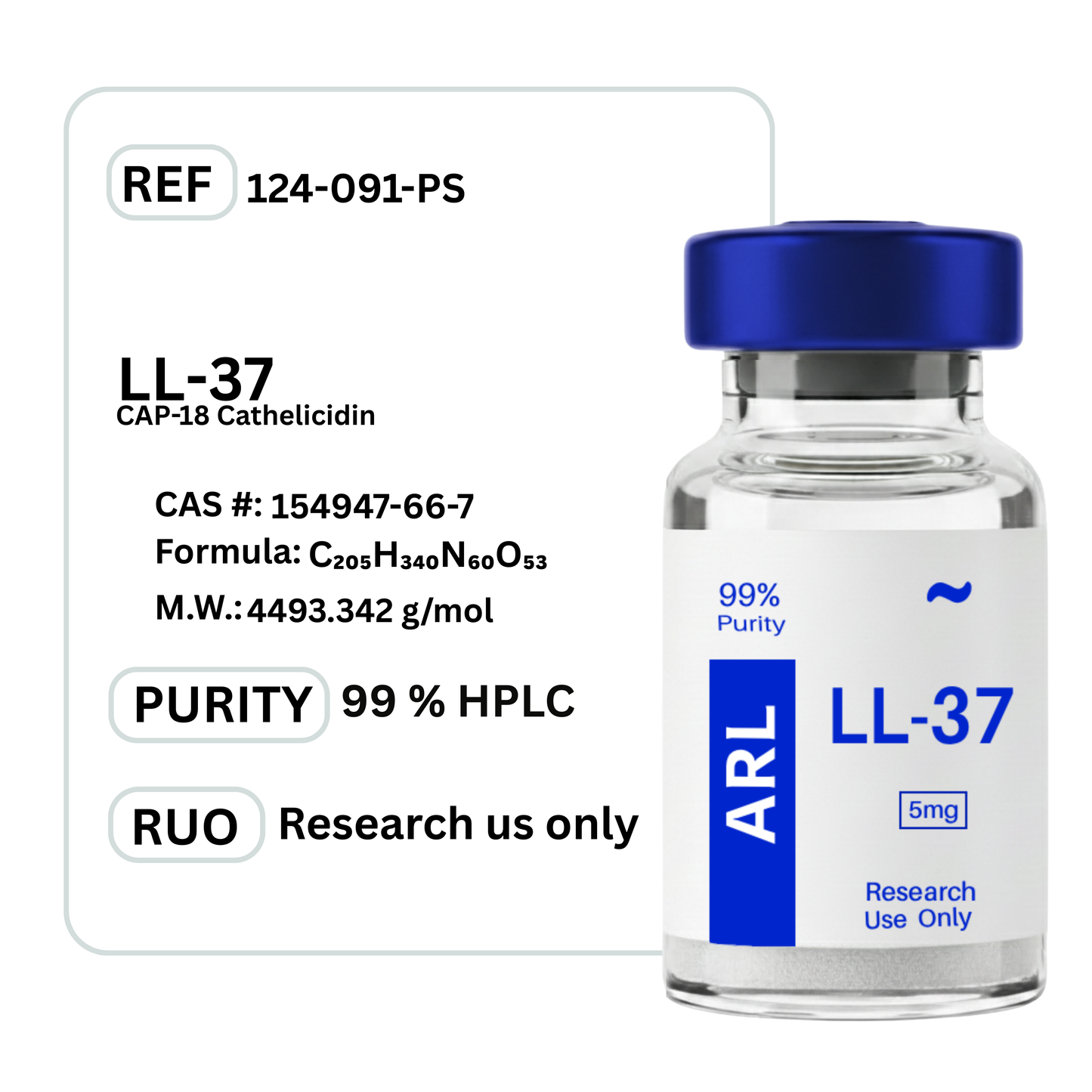
LL-37
LL-37
This batch of LL-37 Antimicrobial Peptide has been third party lab tested and verified for quality.
Contents: LL-37
Form: Powder
Purity: 99.3%
Couldn't load pickup availability
Free Reconstitution Solution automatically added to your cart with each order.
This product is Made, Tested & Shipped From Canada.
Ships Today
Order by 1:00 PM EST
Free Shipping
For 2 or more vials
Verified+

LL-37 Peptide Overview
LL-37 is a high-purity, laboratory-synthesized peptide that precisely replicates the molecular structure of the only known human cathelicidin antimicrobial peptide. Composed of 37 amino acids, this peptide is characterized by its unique N-terminal sequence beginning with two leucine residues, which provides the basis for its nomenclature as "LL-37." In biological systems, LL-37 is liberated from the C-terminus of the precursor protein hCAP-18 through specialized enzymatic cleavage. It is naturally expressed in epithelial tissues and various circulating immune cells. Current scientific inquiry focuses on the peptide’s multifaceted roles in antimicrobial defense, immunomodulation, and tissue regeneration within strictly controlled experimental and preclinical environments.
LL-37 Peptide Structure
The structural integrity of LL-37 is fundamental to its biological utility. It is a cationic, amphipathic alpha-helical peptide, a configuration that allows it to interact dynamically with both lipid membranes and various cellular receptors.
Molecular Specifications:
- Amino Acid Count: 37 residues
- Sequence: LLGDFFRKSKEKIGKEFKRIVQRIKDFLRNLVPRTES
- Molecular Formula: C205H340N60O53
- Molecular Weight: 4493.3 g/mol
Property
Specification
Physical Appearance
Lyophilized White Powder
Peptide Purity
Greater than 98 percent
Solubility
Water Soluble
Source
Chemical Synthesis
Net Charge
+6 at physiological pH
LL-37 Peptide Research
LL-37 and Inflammatory Conditions
While LL-37 is recognized for its defensive capabilities, research has identified its presence in several complex inflammatory pathways, including those associated with psoriasis, lupus, rheumatoid arthritis, and atherosclerosis. The behavior of the peptide is highly context-dependent, varying significantly based on the local inflammatory environment and the specific cell types involved.
Experimental data suggests that LL-37 can mitigate keratinocyte apoptosis and modulate the production of interferon-alpha. Furthermore, it has been observed to influence the migration of neutrophils and eosinophils while suppressing signaling through toll-like receptor 4. These findings indicate that LL-37 acts as a homeostatic regulator, attempting to stabilize immune activity and prevent runaway inflammation during systemic stress. Recent evidence suggests that elevated levels of LL-37 in autoimmune contexts may represent a protective response by the body to restore balance rather than a driver of the disease itself.
LL-37 as a Potent Antimicrobial Agent
As a cornerstone of the innate immune system, LL-37 serves as a primary defense against pathogens. In healthy skin, LL-37 levels are generally low but escalate rapidly upon the detection of invading microorganisms. The peptide exhibits broad-spectrum activity against Gram-positive and Gram-negative bacteria, fungi, and certain enveloped viruses.
The mechanism of action is largely attributed to its interaction with bacterial lipopolysaccharide (LPS). By binding to LPS, LL-37 disrupts the stability of the bacterial outer membrane, leading to membrane permeabilization. Additionally, LL-37 has been shown to work in synergy with other molecules, such as human beta-defensin 2 and lysozyme, to amplify the overall efficacy of the host's antimicrobial response.
LL-37 and Respiratory Health
The presence of LPS is not limited to bacterial infections; it is also found in airborne contaminants like mold and fungi. Inhalation of these particles triggers LL-37 production in lung tissue. Research is currently investigating the potential of exogenous LL-37 as a therapeutic model for managing lung inflammation related to toxic dust syndrome, asthma, and COPD.
Beyond defense, LL-37 appears to promote respiratory tissue repair. It stimulates the proliferation and migration of airway epithelial cells, facilitating the closure of wounds and the restoration of damaged tissue. By promoting angiogenesis, LL-37 supports the growth of new blood vessels necessary for supplying nutrients to regenerating lung segments.
Understanding LL-37 in Arthritis
In studies involving rheumatoid arthritis, researchers have noted significant concentrations of LL-37 within synovial joints. While earlier theories questioned if the peptide contributed to joint degradation, current evidence points toward a protective role. Animal models lacking the LL-37 gene show no improvement in arthritic symptoms, suggesting the peptide is a byproduct of the inflammation rather than the cause.
Furthermore, LL-37 and its derived analogs have demonstrated the ability to protect against collagen degradation. In laboratory settings, the administration of LL-37 peptides to inflamed joints resulted in a reduction of disease severity and a decrease in serum antibodies against type II collagen. This indicates that LL-37 may selectively mitigate joint inflammation by interacting with receptors such as TLR3 and TLR4.
LL-37 and Intestinal Health
Research using intestinal cell cultures shows that LL-37 supports the integrity of the intestinal barrier by promoting epithelial cell migration and reducing programmed cell death. These protective qualities suggest potential utility in studying inflammatory bowel diseases and recovery from intestinal surgery.
LL-37 works alongside human beta-defensin 2 to restore epithelial integrity and mitigate damage caused by TNF-alpha. Because current treatments for intestinal inflammation often carry risks of systemic infection, LL-37-based research offers a pathway toward developing targeted modulators that maintain gut health without compromising the broader immune system.
LL-37 and Intestinal Cancer
Investigations into the relationship between LL-37 and oncology have revealed promising results in the context of gastric and intestinal cancers. The peptide appears to exert anti-tumor effects through a vitamin D-dependent mechanism. Research suggests that vitamin D enhances the ability of macrophages to combat tumors specifically by upregulating LL-37, highlighting a synergistic pathway that may contribute to reduced gastrointestinal cancer risks.
LL-37 and Blood Vessel Formation
LL-37 influences the production of prostaglandin E2 (PGE2) in endothelial cells. While PGE2 is often associated with inflammatory pain, it is also a critical driver of angiogenesis. The ability of LL-37 to modulate the formation of new blood vessels makes it a vital subject of study for wound healing, stroke recovery, and the management of cardiovascular health.
Ongoing LL-37 Research
The structural divergence of LL-37 between humans and other mammals provides a unique opportunity for biophysical study. Even when sharing core sequences, the three-dimensional folding of the peptide determines its specific receptor binding and biological impact. This makes LL-37 an essential model for understanding protein engineering and the design of targeted therapeutic peptides.
While LL-37 demonstrates high subcutaneous bioavailability in animal models, it is important to note that dosing and physiological effects observed in laboratory animals do not translate directly to human applications.
Article Author
This review was compiled, edited, and organized by Dr. Ayyalusamy Ramamoorthy, Ph.D. Dr. Ramamoorthy is a distinguished biophysical chemist renowned for his extensive research on antimicrobial peptides. His work has been pivotal in defining the structural biology of LL-37, providing the scientific community with a deeper understanding of how this peptide interacts with lipid bilayers and immune receptors to facilitate tissue repair and pathogen clearance.
Scientific Journal Author
Dr. Ayyalusamy Ramamoorthy, Professor of Biophysics and Chemistry at the University of Michigan, has authored several landmark publications, including "LL-37, the only human cathelicidin: structure, function, and applications" (Biochim Biophys Acta, 2006). His collaborations with researchers like Dr. Robert E.W. Hancock and Dr. Judith M. Kahlenberg have established a comprehensive foundation for the study of cathelicidins in modern medicine.
Reference Citations
- Durr UH, Sudheendra US, Ramamoorthy A. LL-37, the only human cathelicidin: structure, function, and applications. Biochim Biophys Acta. 2006;1758(9):1408-1425.
- Vandamme D, et al. A comprehensive summary of LL-37 and its derived peptides. Cell Mol Life Sci. 2012;69(20): 3885-3908.
- Nijnik A, Hancock RE. The roles of cathelicidin LL-37 in immune defences and novel clinical applications. Curr Opin Hematol. 2009;16(1):41-47.
- Overhage J, et al. Human host defense peptide LL-37 prevents bacterial biofilm formation. Infect Immun. 2008;76(9):4176-4182.
- Heilborn JD, et al. The cathelicidin peptide LL-37 is involved in re-epithelialization of human skin wounds and is lacking in chronic ulcers. J Invest Dermatol. 2003;120(3):379-389.
- Barlow PG, et al. Antiviral activity and increased host defense response of LL-37 in influenza virus infection. J Immunol. 2011;186(10): 6166-6174.
- Kahlenberg JM, Kaplan MJ. Little peptide, big effects: the role of LL-37 in inflammation and autoimmune disease. J Immunol. 2013;191(10):4895-4901.
- Mookherjee N, et al. Modulation of the TLR-mediated inflammatory response by LL-37. J Immunol. 2006;176(4):2455-2464.
- Krasnodembskaya A, et al. Human cathelicidin peptide LL-37 promotes mesenchymal stem cell-mediated immunomodulation and tissue repair. Proc Natl Acad Sci USA. 2010;107(32):14292-14297.
- Ramos R, et al. Wound healing activity of LL-37 peptide. Peptides. 2011;32(9):1849-1858.
Storage
Storage Instructions
All LL-37 peptide products are manufactured via lyophilization (freeze-drying), a process that ensures molecular stability during transit for 3 to 4 months. Lyophilization involves freezing the peptide and reducing surrounding pressure to allow the frozen water to sublimate directly from a solid to a gas. This leaves a stable, crystalline powder.
Upon arrival, the lyophilized peptide should be stored in a cool, dark environment. For immediate research needs, refrigeration at 4 degrees Celsius is sufficient. For long-term preservation (months to years), the peptide should be kept in a freezer at -80 degrees Celsius.
Best Practices For Storing Peptides
Proper handling is vital to prevent degradation, oxidation, and contamination.
- Reconstitution: Once the peptide is reconstituted with bacteriostatic water, it must be refrigerated and used within 30 days.
- Temperature Consistency: Avoid frost-free freezers, as temperature cycles during the defrost phase can damage the peptide’s structural integrity.
- Contamination Prevention: Always allow the vial to reach room temperature before opening to prevent moisture condensation inside the container.
Preventing Oxidation and Moisture Contamination
To protect the peptide from air exposure, keep the container sealed whenever possible. Researchers may use an inert gas like nitrogen or argon to blanket the peptide before sealing to prevent oxidation. Dividing the peptide into smaller aliquots for individual experiments is recommended to avoid repeated freeze-thaw cycles.
Storing Peptides In Solution
Peptide solutions are less stable than their lyophilized counterparts. If a solution must be stored, use a sterile buffer with a pH between 5 and 6. Aliquoting is essential here to minimize temperature fluctuations. While refrigerated solutions can last up to 30 days, any peptide not intended for immediate use should remain in its lyophilized state.
Peptide Storage Containers
High-quality glass vials are preferred for their chemical inertness and clarity. However, polypropylene plastic vials are often used for shipping to prevent breakage. Researchers may transfer the product between containers as needed, provided the new container is clean, sterile, and chemically resistant.
-
check_circle
HIGHEST QUALITY PEPTIDES
Our products are scientifically formulated and manufactured in cGMP-compliant facilities.
-
encrypted
FAST DELIVERY
Enjoy fast and reliable 3–5 day shipping.
-
check_circle
Dedicated Customer Service
Our customer service team is highly knowledgeable in peptide research and its applications. We’re available 24/7 to assist you.
Verified reviews
Tested. Verified. Trusted.
We take a laboratory-first approach to quality. Each batch is made under controlled conditions and verified by an independent lab (HPLC/MS). We only ship batches that test ≥99% purity, and we provide a full COA, including identity, methods, and chromatograms, for your review.
You may also like
-
SAVE 25%Reconstitution Solution
Regular price $15.00Regular price $15.00 Sale priceUnit price / per$20.0025% -
SAVE 24%PEG MGF - Research Grade Peptide
Regular price $100.00Regular price $100.00 Sale priceUnit price / per$132.0024% -
SAVE 25%Tirzepatide
Regular price From $50.00Regular price From $50.00 Sale priceUnit price / per$67.0025% -
SAVE 24%Thymosin Alpha-1
Regular price From $79.00Regular price From $79.00 Sale priceUnit price / per$104.0024% -
SAVE 23%Tesamorelin
Regular price From $80.00Regular price From $80.00 Sale priceUnit price / per$105.0023% -
SAVE 23%Survodutide
Regular price $299.00Regular price $299.00 Sale priceUnit price / per$392.0023% -
SAVE 26%Sterile Water
Regular price From $14.00Regular price From $14.00 Sale priceUnit price / per$19.0026% -
SAVE 23%SLU-PP-332
Regular price $125.00Regular price $125.00 Sale priceUnit price / per$164.0023% -
SAVE 23%Sermorelin
Regular price From $70.00Regular price From $70.00 Sale priceUnit price / per$92.0023% -
SAVE 23%Semaglutide
Regular price From $36.00Regular price From $36.00 Sale priceUnit price / per$47.0023% -
SAVE 23%Retatrutide Triple Agonist
Regular price From $90.00Regular price From $90.00 Sale priceUnit price / per$118.0023% -
SAVE 24%PEG MGF - Premium Research Peptide
Regular price $100.00Regular price $100.00 Sale priceUnit price / per$132.0024% -
SAVE 26%Oxytocin Acetate
Regular price $42.00Regular price $42.00 Sale priceUnit price / per$57.0026% -
SAVE 25%Melanotan II (MT2)
Regular price $50.00Regular price $50.00 Sale priceUnit price / per$67.0025% -
SAVE 24%Lipo-C with B Vitamins
Regular price $85.00Regular price $85.00 Sale priceUnit price / per$112.0024% -
SAVE 23%Lemon Bottle
Regular price $80.00Regular price $80.00 Sale priceUnit price / per$105.0023% -
SAVE 23%L-Carnitine
Regular price $97.00Regular price $97.00 Sale priceUnit price / per$127.0023% -
SAVE 24%KPV Tripeptide
Regular price From $56.00Regular price From $56.00 Sale priceUnit price / per$74.0024% -
KLOW Blend - GHK-CU + TB-500 + BPC-157 + KPV 10mg
Regular price $200.00Regular price $200.00 Sale priceUnit price / per$261.0023% -
SAVE 23%Kisspeptin-10
Regular price From $65.00Regular price From $65.00 Sale priceUnit price / per$85.0023% -
SAVE 23%Ipamorelin
Regular price From $32.00Regular price From $32.00 Sale priceUnit price / per$42.0023% -
SAVE 24%IGF-DES - Premium Research Peptide
Regular price $60.00Regular price $60.00 Sale priceUnit price / per$79.0024% -
IGF-1 LR3 (Long R3) - Premium Research Peptide
Regular price From $40.00Regular price From $40.00 Sale priceUnit price / per$53.0024% -
SAVE 24%Hyaluronic
Regular price $28.00Regular price $28.00 Sale priceUnit price / per$37.0024% -
SAVE 23%HGH Fragment 176-191
Regular price $97.00Regular price $97.00 Sale priceUnit price / per$127.0023% -
SAVE 23%HGH 191AA (Somatropin)
Regular price From $55.00Regular price From $55.00 Sale priceUnit price / per$72.0023% -
SAVE 25%Gonadorelin
Regular price $50.00Regular price $50.00 Sale priceUnit price / per$67.0025% -
SAVE 23%Glutathione
Regular price $83.00Regular price $83.00 Sale priceUnit price / per$109.0023% -
SAVE 23%Glow BPC-157 + GHK-CU + TB-500
Regular price $139.00Regular price $139.00 Sale priceUnit price / per$181.0023%
Every vial we sell comes from a lab that follows current Good Manufacturing Practices (cGMP). That means each step of production is documented and controlled. Before a batch is released, it’s tested by independent third-party labs for purity, identity, and sterility. Certificates of analysis are available so you can see the exact test results.
Yes. The labs we work with use ISO-certified clean rooms where air quality, equipment, and handling procedures are tightly regulated. Staff are trained to pharmaceutical-grade standards. This ensures the peptides are produced in an environment that minimizes contamination risks.
Peptides in lyophilized (freeze-dried) form are stable at room temperature for transport. Once you receive them, refrigeration is recommended to maintain long-term integrity. We package every order securely to prevent damage and ship promptly, so your vials arrive in optimal condition.
We operate under strict in-house protocols that follow current Good Manufacturing Practices (cGMP). That means our team oversees the entire process from sourcing raw amino acids to the final lyophilized vial. Nothing is outsourced or repackaged. This gives us full control over purity, consistency, and sterility, and it’s why we can stand behind every single vial we ship.
Store them in the refrigerator, away from direct light and heat. If you need to keep them longer, some peptides can be stored frozen. Each vial comes with clear handling instructions so you know the proper conditions for stability.
The strongest proof is transparency. For every peptide, we can provide certificates of analysis, manufacturing documentation, and references to the published scientific research behind it. If you ever have questions, we’ll show you the data rather than ask you to take our word for it.
The difference is transparency. Most sites give you a product name and a price. We provide full batch testing, lab documentation, and direct access to certificates of analysis so you don’t have to guess what you’re getting. When you order from us, you know exactly what’s in the vial, where it was made, and how it was verified.