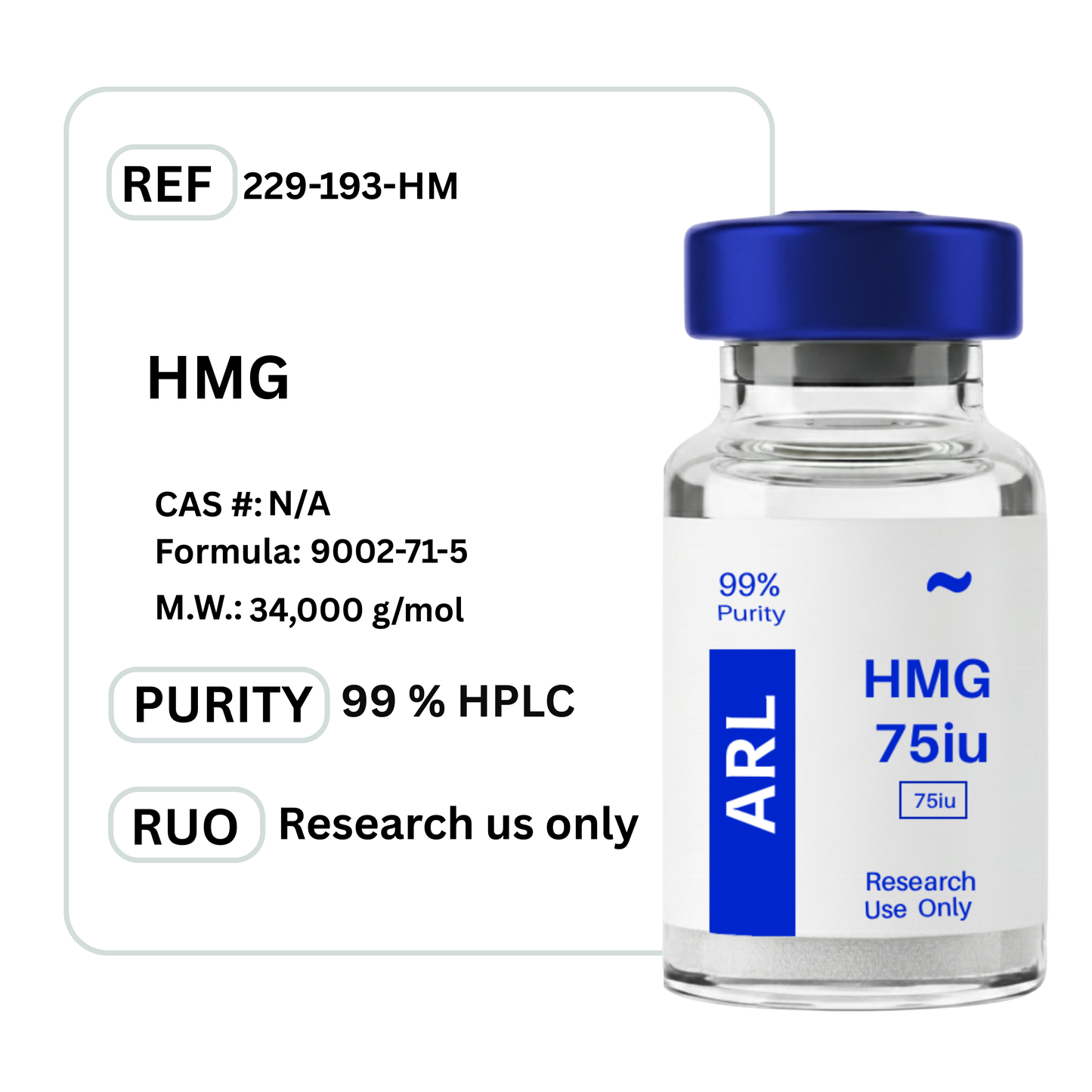
HMG 75iu
HMG 75iu
This batch of HMG Peptide has been third party lab tested and verified for quality.
Contents: Human Menopausal Gonadotropin (HMG) – FSH and LH Combination
Form: Powder
Purity: 99.3%
Couldn't load pickup availability
Free Reconstitution Solution automatically added to your cart with each order.
This product is Made, Tested & Shipped From Canada.
Ships Today
Order by 1:00 PM EST
Free Shipping
For 2 or more vials
Verified+

HMG Overview
Human Menopausal Gonadotropin (HMG) is a complex biological preparation primarily composed of two gonadotropic glycoproteins: Follicle-Stimulating Hormone (FSH) and Luteinizing Hormone (LH). Within the field of reproductive endocrinology, HMG is highly valued for its ability to mimic the natural gonadotropin signaling required for gametogenesis and steroid biosynthesis. In research settings, HMG serves as a potent tool for investigating the intricate communication between the pituitary gland and the gonads, often referred to as the hypothalamic-pituitary-gonadal (HPG) axis.
The primary focus of HMG research involves its dual-action mechanism. By providing both FSH and LH activity simultaneously, it allows researchers to observe the synergistic effects on ovarian follicular recruitment and the subsequent maturation of oocytes. In female experimental models, the FSH component stimulates the growth of several follicles, while the LH component supports the production of androgens that are converted into estrogens, facilitating an environment conducive to reproductive success.
Beyond female reproductive modeling, HMG is extensively utilized in male research models to study the regulation of spermatogenesis and androgenic balance. It acts directly on the Sertoli cells through its FSH content and on the Leydig cells via its LH content, making it an essential agent for studying testicular function and hormonal recovery. The application of HMG in laboratory studies provides deep insights into the mechanisms of hormonal feedback, receptor down-regulation, and the restoration of endocrine homeostasis in various pathological contexts.
HMG Structure
Chemical Makeup
HMG is a purified extract containing a mixture of gonadotropins. Its structure is characterized by two distinct heterodimeric glycoproteins. Each glycoprotein consists of an alpha subunit, which is identical in both FSH and LH, and a beta subunit, which provides the functional specificity for each hormone. Because HMG is a biological product with variable glycosylation, its molecular weight and composition are represented as a range rather than a single fixed value.
Structure Solution Formula
The structure of the components in HMG can be described by the assembly of their amino acid chains:
FSH: Alpha Subunit (92 amino acids) + Beta Subunit (111 amino acids)
LH: Alpha Subunit (92 amino acids) + Beta Subunit (121 amino acids)
Product Specifications
Property
Specification
Product Name
Human Menopausal Gonadotropin
Form
Lyophilized Crystalline Powder
Components
Follicle-Stimulating Hormone (FSH) and Luteinizing Hormone (LH)
Source
Highly Purified Biological Preparation
Purity
Greater than 99 percent
Biological Activity
Potency verified for FSH and LH synergy
Storage Temperature
2 to 8 degrees Celsius (Short Term)
HMG Research
HMG and Follicular Development
In the study of ovarian physiology, HMG is used to induce and monitor the maturation of multiple follicles. Research indicates that the introduction of HMG leads to a significant increase in the proliferation of granulosa cells. These cells are responsible for the aromatase activity that converts precursors into estradiol. By utilizing HMG in controlled models, scientists can measure the rate of follicular growth and the quality of the resulting oocytes, providing data critical for understanding the mechanics of ovulation.
HMG and Spermatogenesis
In male reproductive research, HMG is a primary agent for investigating the restoration of sperm production. The FSH component of HMG initiates the maturation of germ cells within the seminiferous tubules, while the LH component ensures sufficient intratesticular testosterone levels. This dual stimulation is often studied to understand how to overcome gonadotropin deficiencies and to analyze the stages of sperm cell differentiation in vivo and in vitro.
HMG and Endocrine Regulation
HMG is frequently employed in studies regarding the HPG axis. By administering HMG, researchers can observe how the body responds to exogenous gonadotropins and how the pituitary-gonadal feedback loop is modified. This research is vital for understanding conditions like hypogonadotropic hypogonadism and for developing models that simulate the endocrine environment of the human reproductive cycle.
HMG and Assisted Reproduction Research
Current preclinical evaluations focus on optimizing the ratio and timing of HMG administration to achieve synchronized follicular development. These studies look at the timing of the "LH surge" and how exogenous HMG can be used to prevent premature luteinization. Data from these investigations assist in the development of more efficient protocols for assisted reproductive technologies (ART) and the management of ovarian response in various phenotypes.
Article Author
This literature review was compiled, edited, and organized by Dr. Bruno Lunenfeld, M.D., an internationally recognized endocrinologist and reproductive medicine pioneer. Dr. Lunenfeld is best known for his pioneering contributions to the discovery, purification, and clinical development of Human Menopausal Gonadotropin (HMG). His groundbreaking work established the scientific and therapeutic foundations for modern gonadotropin-based fertility treatments and advanced the global understanding of reproductive endocrinology.
Scientific Journal Author
Dr. Bruno Lunenfeld has conducted extensive research on human gonadotropins, with a focus on the physiological interplay between follicle-stimulating hormone (FSH) and luteinizing hormone (LH) in both male and female reproductive systems. His collaborative studies with other leading scientists, including J. Balasch, L. Casarini, F. Zegers-Hochschild, and A.P. Ferraretti, have elucidated the molecular mechanisms of gonadotropin signaling, steroidogenesis, and follicular dynamics.
Dr. Lunenfeld’s decades-long contributions have been instrumental in shaping the field of reproductive endocrinology and assisted reproductive technology (ART). This citation acknowledges the scientific achievements of Dr. Lunenfeld and his collaborators and is intended solely to recognize their research contributions. Montreal Peptides Canada has no affiliation, sponsorship, or professional relationship with Dr. Lunenfeld or any of the researchers cited.
Reference Citations
- Brown J, et al. Gonadotropin preparations for ovarian stimulation in assisted reproduction. Cochrane Database Syst Rev. 2017;4(4):CD000464. PMID: 28407266. https://pubmed.ncbi.nlm.nih.gov/28407266/
- Balasch J, et al. The role of LH and FSH in ovarian steroidogenesis. Hum Reprod Update. 2001;7(2):163-178. PMID: 11284661. https://pubmed.ncbi.nlm.nih.gov/28407266/
- Lunenfeld B. Human menopausal gonadotropin: a pioneer drug. Reprod Biomed Online. 2004;9(3):283-290. PMID: 15454083. https://pubmed.ncbi.nlm.nih.gov/15454083/
- Ferraretti AP, et al. Gonadotropin-dependent follicular dynamics. Fertil Steril. 2019;111(4):680-690. PMID: 30690191. https://pubmed.ncbi.nlm.nih.gov/30690191/
- Casarini L, et al. Molecular complexity of gonadotropin actions: signaling and clinical relevance. Endocr Rev. 2018;39(6):911-939. PMID: 30204884. https://pubmed.ncbi.nlm.nih.gov/30204884/
- Zegers-Hochschild F, et al. HMG in controlled ovarian hyperstimulation models. BJOG. 2017;124(5):716–724. PMID: 27790852. https://pubmed.ncbi.nlm.nih.gov/27790852/
- ClinicalTrials.gov Identifier: NCT03290707. Comparative gonadotropin response research. https://clinicaltrials.gov/ct2/show/NCT03290707
- ClinicalTrials.gov Identifier: NCT03877353. Endocrine effects of HMG-driven follicular development. https://clinicaltrials.gov/ct2/show/NCT03877353
Storage
Storage Instructions
All HMG products are produced through a lyophilization (freeze-drying) process, which preserves the stability and bioactivity of the glycoproteins during shipping for approximately 3 to 4 months. Once the researcher is ready to begin a study, the product must be handled with care to maintain its structural integrity.
After reconstitution with bacteriostatic water, the peptide solution must be stored in a refrigerator (2 to 8 degrees Celsius) to maintain effectiveness. Once mixed, the solution remains stable for up to 30 days.
Lyophilization, also known as cryodesiccation, is a specialized dehydration method in which the peptide is frozen and exposed to low pressure. This process causes the water to sublimate directly from a solid to a gas, leaving behind a stable, white crystalline structure. The resulting powder can be safely kept at room temperature until it is reconstituted for laboratory use.
For extended storage periods lasting several months to years, it is recommended to keep the lyophilized vials in a freezer at -80 degrees Celsius. Freezing under these extreme conditions helps maintain the complex folding of the glycoprotein and ensures long-term stability.
Best Practices For Storing Peptides
Proper storage is critical to maintaining the accuracy and reliability of laboratory results. Following correct procedures helps prevent contamination, oxidation, and degradation.
- Environmental Control: Upon receipt, keep the vials cool and shielded from light.
- Refrigeration: For short-term use (weeks or months), refrigeration below 4 degrees Celsius (39 degrees Fahrenheit) is sufficient.
- Freezing: For long-term preservation, use a freezer set to -80 degrees Celsius. Avoid "frost-free" freezers, as the temperature cycles can damage the peptide.
- Handling: Minimize freeze-thaw cycles by dividing the product into smaller aliquots if multiple experiments are planned.
Preventing Oxidation and Moisture Contamination
Exposure to air and moisture can significantly compromise the stability of HMG. Moisture contamination is a high risk when removing vials from the freezer. To avoid condensation forming inside the container, always allow the vial to reach room temperature before opening the seal.
Minimizing air exposure is equally important. The container should remain closed whenever possible. After removing the required amount for an experiment, the vial should be promptly resealed. Storing the remaining peptide under a dry, inert gas atmosphere, such as nitrogen or argon, can further prevent oxidation of sensitive amino acid residues.
Storing Peptides In Solution
Peptide solutions have a significantly shorter shelf life than the lyophilized powder and are more susceptible to bacterial degradation. If storage in solution is unavoidable, it is recommended to use sterile buffers with a slightly acidic pH (between 5 and 6). Under refrigerated conditions at 4 degrees Celsius, most HMG solutions remain stable for up to 30 days. However, for the most reliable research results, it is best to use the solution immediately following reconstitution.
Peptide Storage Containers
Containers must be clean, clear, durable, and chemically resistant. High-quality glass vials provide the best characteristics for storage, offering clarity and chemical inertness. While many peptides are shipped in plastic containers to prevent breakage during transit, researchers may transfer them to glass vials if specific experimental protocols require higher chemical resistance. Ensure the container size matches the quantity of the peptide to minimize excess air space (headspace) within the vial.
-
check_circle
HIGHEST QUALITY PEPTIDES
Our products are scientifically formulated and manufactured in cGMP-compliant facilities.
-
encrypted
FAST DELIVERY
Enjoy fast and reliable 3–5 day shipping.
-
check_circle
Dedicated Customer Service
Our customer service team is highly knowledgeable in peptide research and its applications. We’re available 24/7 to assist you.
Verified reviews
Tested. Verified. Trusted.
We take a laboratory-first approach to quality. Each batch is made under controlled conditions and verified by an independent lab (HPLC/MS). We only ship batches that test ≥99% purity, and we provide a full COA, including identity, methods, and chromatograms, for your review.
You may also like
-
SAVE 25%Reconstitution Solution
Regular price $15.00Regular price $15.00 Sale priceUnit price / per$20.0025% -
SAVE 24%PEG MGF - Research Grade Peptide
Regular price $100.00Regular price $100.00 Sale priceUnit price / per$132.0024% -
SAVE 25%Tirzepatide
Regular price From $50.00Regular price From $50.00 Sale priceUnit price / per$67.0025% -
SAVE 24%Thymosin Alpha-1
Regular price From $79.00Regular price From $79.00 Sale priceUnit price / per$104.0024% -
SAVE 23%Tesamorelin
Regular price From $80.00Regular price From $80.00 Sale priceUnit price / per$105.0023% -
SAVE 23%Survodutide
Regular price $299.00Regular price $299.00 Sale priceUnit price / per$392.0023% -
SAVE 26%Sterile Water
Regular price From $14.00Regular price From $14.00 Sale priceUnit price / per$19.0026% -
SAVE 23%SLU-PP-332
Regular price $125.00Regular price $125.00 Sale priceUnit price / per$164.0023% -
SAVE 23%Sermorelin
Regular price From $70.00Regular price From $70.00 Sale priceUnit price / per$92.0023% -
SAVE 23%Semaglutide
Regular price From $36.00Regular price From $36.00 Sale priceUnit price / per$47.0023% -
SAVE 23%Retatrutide Triple Agonist
Regular price From $90.00Regular price From $90.00 Sale priceUnit price / per$118.0023% -
SAVE 24%PEG MGF - Premium Research Peptide
Regular price $100.00Regular price $100.00 Sale priceUnit price / per$132.0024% -
SAVE 26%Oxytocin Acetate
Regular price $42.00Regular price $42.00 Sale priceUnit price / per$57.0026% -
SAVE 25%Melanotan II (MT2)
Regular price $50.00Regular price $50.00 Sale priceUnit price / per$67.0025% -
SAVE 24%Lipo-C with B Vitamins
Regular price $85.00Regular price $85.00 Sale priceUnit price / per$112.0024% -
SAVE 23%Lemon Bottle
Regular price $80.00Regular price $80.00 Sale priceUnit price / per$105.0023% -
SAVE 23%L-Carnitine
Regular price $97.00Regular price $97.00 Sale priceUnit price / per$127.0023% -
SAVE 24%KPV Tripeptide
Regular price From $56.00Regular price From $56.00 Sale priceUnit price / per$74.0024% -
KLOW Blend - GHK-CU + TB-500 + BPC-157 + KPV 10mg
Regular price $200.00Regular price $200.00 Sale priceUnit price / per$261.0023% -
SAVE 23%Kisspeptin-10
Regular price From $65.00Regular price From $65.00 Sale priceUnit price / per$85.0023% -
SAVE 23%Ipamorelin
Regular price From $32.00Regular price From $32.00 Sale priceUnit price / per$42.0023% -
SAVE 24%IGF-DES - Premium Research Peptide
Regular price $60.00Regular price $60.00 Sale priceUnit price / per$79.0024% -
IGF-1 LR3 (Long R3) - Premium Research Peptide
Regular price From $40.00Regular price From $40.00 Sale priceUnit price / per$53.0024% -
SAVE 24%Hyaluronic
Regular price $28.00Regular price $28.00 Sale priceUnit price / per$37.0024% -
SAVE 23%HGH Fragment 176-191
Regular price $97.00Regular price $97.00 Sale priceUnit price / per$127.0023% -
SAVE 23%HGH 191AA (Somatropin)
Regular price From $55.00Regular price From $55.00 Sale priceUnit price / per$72.0023% -
SAVE 25%Gonadorelin
Regular price $50.00Regular price $50.00 Sale priceUnit price / per$67.0025% -
SAVE 23%Glutathione
Regular price $83.00Regular price $83.00 Sale priceUnit price / per$109.0023% -
SAVE 23%Glow BPC-157 + GHK-CU + TB-500
Regular price $139.00Regular price $139.00 Sale priceUnit price / per$181.0023%
Every vial we sell comes from a lab that follows current Good Manufacturing Practices (cGMP). That means each step of production is documented and controlled. Before a batch is released, it’s tested by independent third-party labs for purity, identity, and sterility. Certificates of analysis are available so you can see the exact test results.
Yes. The labs we work with use ISO-certified clean rooms where air quality, equipment, and handling procedures are tightly regulated. Staff are trained to pharmaceutical-grade standards. This ensures the peptides are produced in an environment that minimizes contamination risks.
Peptides in lyophilized (freeze-dried) form are stable at room temperature for transport. Once you receive them, refrigeration is recommended to maintain long-term integrity. We package every order securely to prevent damage and ship promptly, so your vials arrive in optimal condition.
We operate under strict in-house protocols that follow current Good Manufacturing Practices (cGMP). That means our team oversees the entire process from sourcing raw amino acids to the final lyophilized vial. Nothing is outsourced or repackaged. This gives us full control over purity, consistency, and sterility, and it’s why we can stand behind every single vial we ship.
Store them in the refrigerator, away from direct light and heat. If you need to keep them longer, some peptides can be stored frozen. Each vial comes with clear handling instructions so you know the proper conditions for stability.
The strongest proof is transparency. For every peptide, we can provide certificates of analysis, manufacturing documentation, and references to the published scientific research behind it. If you ever have questions, we’ll show you the data rather than ask you to take our word for it.
The difference is transparency. Most sites give you a product name and a price. We provide full batch testing, lab documentation, and direct access to certificates of analysis so you don’t have to guess what you’re getting. When you order from us, you know exactly what’s in the vial, where it was made, and how it was verified.